
2026-10-30
Keeping city people safe and healthy is becoming a huge challenge in an overheating world, but our Greens Sustainable Cities policies are an excellent place to start in dealing with that challenge
By Rob Delves, a member of the Green Issue editorial team
Overview: What is the problem and how did we get here?
It’s been long-known that cities function as “Heat Islands” – all those hard surfaces, factories and lack of green spaces make every city several degrees hotter than its surrounding countryside. New York is a classic example, measured on average at three degrees hotter than its rural surrounds and up to eight degrees on summer nights.
I had a quirky experience of the heat island effect every winter when I was cycling to work in London in the 1980s. My home was in north London and my workplace was ten miles further north, well into the Greenbelt countryside. Whenever there was snow or severe frost, I stopped riding for a few days until there was no dangerous black ice on the roads. Of course, there were still patches of black ice outside the heat island and being a slow learner, I skidded and crashed several times every year during winter.
However, the problem we’re talking about is not cities having less snow and ice in winter. Instead, it’s the summers becoming unbearable due to climate change supercharging the heat island effect. Europe’s record-breaking 2026 summer is the most recent example. The heat broke many records, often by wide margins. It started in May, with London recording 35.1°C. By mid-August, Europeans were into their fifth heatwave of the season, with temperatures well above 40 degrees across a broad area. The buildings of most European cities are designed for relatively mild summers, and therefore this extreme heat upended everyday life. Hospitalizations and heat-related deaths spiked. Climate scientists warn that Europe’s 2026 experience is not the “new normal” ‒ unless deep cuts are made in greenhouse emissions, much worse heat is coming.
People living within each heat island experience the summer hothouse differently. Depending on their wealth and social class, some cope fairly easily with the health threats posed by heat, while people in poorer neighbourhoods have limited options to reduce their heat stress. I will argue that confronting the equity issue should be a top priority in policies around resilient cities.
Australia’s largest cities are nearly all located on oceans and bays, which provide some cooling relief during heatwaves. Or they used to. As their suburbs expand inland, the maritime cooling effect weakens, and extreme heat becomes a major health issue. Suburbs 30+ km from the ocean in western Sydney are very different to the harbourside or Bondi. Once again, we are confronted by the equity issue. Sydney’s “westies” are much poorer and thus less able to cope with big heat than those in the “Harbourside dress circle” and the northern beaches.
My other main argument is that the design of buildings and neighbourhoods matters enormously. Australia has a history of building homes designed to stay liveable in our long hot summers – large verandas and shady trees keep the hot sun off windows and encourage living outside in summer early mornings and evenings. In recent decades we have lost that tradition. I think the design of most urban fringe estates is a lesson in how not to build resilient neighbourhoods: just plonk large poorly designed homes on small treeless blocks and assume that aircon will solve any problems thrown up by climate change. It’s a solution based on fighting nature instead of trying to work with it. And the cost of buying and running aircon also makes it an expensive solution for many households struggling with today’s cost of living challenges, especially when the suburb is also designed to make cars, by far the most expensive transport mode, the only choice available.
What are the solutions?
Essentially our Greens sustainable cities policies are also what we need to ensure cities are resilient to the threats of an overheating planet. Here are the four main policies I see The Greens offering as the solutions to making cities safer for everyone in a world of unprecedented threats from more extreme heat.
1. Equity
Equity demands that disadvantaged households and suburbs are given the highest priority in all initiatives to cope with extreme heat. John Rawls’ famous Difference Principle states that any increase in inequality can only be justified ethically if it clearly makes a positive difference to the well-being of the most disadvantaged. I think The Greens should adapt this ethical principle to the issue of resilience to urban heat: Any initiative must pass the Rawls’ Difference Test, which means the initiative must clearly improve living conditions of the most disadvantaged.
For example, one frequently suggested initiative is to set up designated cooling centres that people can access to get relief during periods of extreme heat. Middle class people have air con at home and work, and money to spend in aircon shopping malls, whereas many poorer households don’t have these. Libraries are an obvious choice as cooling centres, but they can’t accommodate many people and don’t provide any assistance apart from aircon comfort (and the joy of books). We need more designated cooling centres and equity demands that our priority should be placing them in easy walking distance access for low-income households. Some US cities mandate that their cooling centres are carefully located close to public housing estates. Phoenix is a good example of this. The city has designated 24-hour cooling centres with a variety of services and supports, especially in disadvantaged suburbs.
The Victorian and ACT Greens have proposed some interesting heat-coping initiatives under the heading of active cooling systems. Examples include urban misting systems, green transit corridors (like green tram tracks that absorb less heat than concrete), and water features to create physical "thermal oases" in city squares. Hopefully all of them targeting lower-income areas!
The equity problem is stark in our Australian cities. The wealthy suburbs are well shaded, while the poorer suburbs are often treeless, especially in the new outer suburban developments where lower-income households settle in search of more affordable homes. It’s the classic “drive until you qualify,” but what it really means is you qualify to be isolated from essential services and activity centres, therefore requiring expensive, long, congested car trips. You also qualify for homes that increase summer heat unless you further stretch your budget with air con. An urgent equity challenge is to design our fringe neighbourhoods so that they have more of the advantages of the older wealthy suburbs, especially their resilience to summer heatwaves.
2. Designing buildings to be comfortable in heatwaves
The principles of green building design that help people cope in extreme summer heat are well known. In fact I think they are mostly just common sense. The main ones were obvious to us when we moved into our 1950s-era home 33 years ago. It had been a rental property for a long time and that partly contributed to just about everything about it being poorly designed to deal with summer heat. There was no shade anywhere, apart from a hardy olive tree down back. The east-west orientation meant that the front and back windows did their usual greenhouse thing, but at least the solution was obvious to us (with a bit of advice from Green friends) – start by doing everything you can to keep the summer sun off the windows and stop heat leaking into inside from your roof.
We achieved this by building front and back verandas and planting lots of shady trees and large bushes to block out the summer sun. The other obvious solution was to replace the decrepit dark red roof tiles with a pale tin roof – adding thick insulation directly under the tin and even thicker on top of the ceiling, which had an amazing moderating effect. His was aided by big French windows that can be thrown open at night.
Our last addition to reduce heat was to rip up most of the driveway and replace it with a narrow path bordered by tall bushes ‒ the effect is like running the cooling triffid gauntlet whenever you venture down what used to be a hot concrete hell. So, after about $30,000 over 25 years I think we have adopted most of The Greens 101 principles for the home design part of Climate Resilient Cities. I’ll ask Brad Pettitt to give us a score.
There’s a growing body of evidence that trees, bushes and other plants should be fully embedded in urban design rather than viewed as pleasant shady attractions and decoration. Several cities have done just this, with lush plants flourishing on rooftops and cascading down buildings, thickly lining streets, plus extravagant green spaces taking over from car parks and roads. The visual impact is moving towards making cities look and feel more like nature, like woodlands and forests. There is strong evidence for the physical and mental health benefits of these bold designs.
Finally, a few thoughts about aircon – good for home comfort, bad for the home budget, bad for the environment? What do The Greens have to say about aircon? It’s an interesting question. It would be disastrously smug to criticise households who rely on aircon. We lived well without any until about ten years ago, when we installed one unit in our kitchen-living room. It was the increase in days without the Fremantle Doctor that persuaded us. Plus getting solar panels and being convinced that the new systems combining heating and cooling functions use relatively little electricity and are close to zero emissions when solar panels are factored in. A home battery is the next obvious step in this direction.
So my answer would be first adopt the well-tested green design principles, since the best way to reduce emissions and costs is to use close to zero electricity to achieve comfortable indoor temperatures. Then second, maybe buy a unit or two for the main living areas. Third, appreciate that Perth suburbs near the ocean have a huge natural ocean breeze advantage compared to suburbs 20+ km inland – so maybe go live there for a while before you start criticising from your Don’t-Need-Aircon Cottesloe comfort zone.
Just thinking off the top of my head here – other ideas welcome.
3. Neighbourhoods that encourage walking rather than car dependence
Walkable, well-connected neighbourhoods have an important advantage for citizens when heatwaves threaten people’s health – they make it much easier for people to check on each other informally. More generally, cities designed for cars rather than people are a disaster for pleasant, healthy vibrant urban living. It turns out that these cities are also a disaster when it comes to keeping people safe during periods of extreme heat.
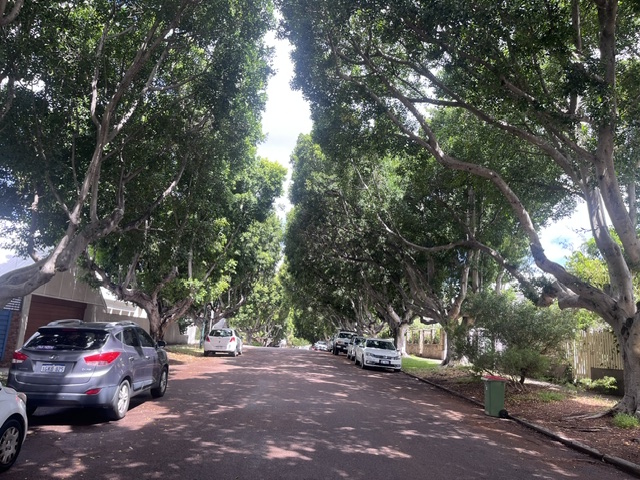 We need to take space away from cars (big hot roads, big hot car parks) and give it over to pedestrians, parks and other cooling green spaces. It goes without saying that in our hot Australian cities, walkability is enhanced by an abundance of large shady trees. There is a strong correlation of car-dependent suburbs with extreme heat and walkable suburbs with milder conditions.
So, The Greens should advocate strongly for boldly reducing road and car parking spaces, mostly replacing them with parks, gardens and street trees. In addition, why not advocate for a planning law that mandates all fringe developments must provide a variety of transport options, in other words, a ban on new developments that only provide for the car option.
The obvious pathway towards reducing car dominance is to provide people with more options for getting around. Another pathway could be promoting car sharing schemes, which would be easier in high density developments. What do Greens think about the role that autonomous vehicles, robo-taxis, etc., combined with AI, could play in reducing car numbers and therefore space devoted to cars, especially parking (theoretically, we could need very few parking spaces indeed – just walking in green shady urban heaven!).
4. Higher density suburbs
Density is really an essential component of Solutions 2 and 3. Higher density makes it easier for each home to reduce exposure to the sun. But medium and high density suburbs have many other advantages: they are less car dependent, more pleasant, healthy vibrant walkable living places. In higher density neighbourhoods, houses and car infrastructure command less space and therefore there are more cooling green spaces such as parks and gardens.
Finally, Some Lessons from Paris
Cars out, green spaces and metro expansion in, but some equity issues?
Starting in 2014, the Environmental/Socialist mayor Anne Hidalgo set out to transform Paris in two ways: firstly, to change it from a car-dominated to a more public transport, pedestrian and bike riding city, and secondly to create a greener city.
She chose to start with a radical attack on car-dominance. The most iconic move was to rip out three kilometres of road beside the Seine and turn it into a riverside park. Car space was also reduced to create more pedestrian areas in other iconic places and several major roads became bicycle boulevards with car use reduced to a limited number of authorised cars.
It was very successful and widely appreciated until it was caught up in the 2018 pushback by the Yellow Vest protestors. Their issue was rising fuel taxes that impacted most heavily on poorer people who lived in outer suburbs and other places where alternatives to car use were almost non-existent. Inevitably, the biggest protests were held in Paris and they were raging in their anger at what they saw as bias in favour of well-off city dwellers who could live well without cars. I think the Yellow Vests had a strong case. Once again, we see the equity issue clashing with well-intentioned efforts to reduce environmental harm and reduce the urban heat island effect. Once again, I say that you can’t solve the challenges of making cities more resilient to rising heat unless equity is front and centre in every initiative.
The 2018 protests slowed down – though did not stop ‒ progress on reducing car space, leading to planting shady trees and other urban greenery becoming the main focus. It’s an easier political battle – who doesn’t like trees? Hidalgo’s aim was to increase tree canopy from a world low of 9%. There has been considerable success, but “it isn’t easy being green!” Tree maintenance becomes a challenge as climate change creates widespread problems: for example, disease problems increase, more irrigation is required, all in a political environment of strained budgets. But even with all that, Parisians love all the extra trees.
The third initiative was driven by the equity issue. Paris has its famous and much-loved metro system but for decades it ignored the expansion of the city, especially to the large working-class estates on the outskirts. Grand Paris Express is a $40 billion program targeted for completion in 2030. It will add 200 km and 68 new stations to the Paris Metro, extending the system into those outer suburbs where people find it difficult to get to the places they need. The Metro is essential to the goal of replacing lots of hot road and other car space with a more walkable green shady environment. Bravo, Paris ‒ $40 billion is a bargain for such an initiative that combines the best of equity and sound urban design for climate resilience.
Header photo: East facing front of Author’s house shaded by vegetation.
[Opinions expressed are those of the author and not official policy of Greens WA]