
2026-01-15
A guide to efficient and cost effective charging of electric vehicle batteries
By Jonathan Hippisley, Solar Enthusiast
EV Energy Consumption
The EVs on the road today consume 10-30kWh/100km. Experts1 describe anything below 15kWh/100km as “efficient”. The Volkswagen e-up is reported to consume 11.5kWh/100km and the Tesla Model 3, 14.7kWh/100km2. The Jaguar I-Pace is reported to consume 27.9kWh/100km1.
Australian private vehicle usage
According to the ABS3, passenger vehicles travelled just under 163 billion km in 2020. That was an average of 11,100km per vehicle. If all of those vehicles had been EVs consuming 15kWh/100km, they would have added just under 3 GW to the existing 30GW load of the major Australian electricity grids (see table below). This would be an increase of around 10%. Bearing in mind that it’s not going to happen today or tomorrow, the electricity grids should be able to handle the extra load as it arises.
EV equivalent energy consumption
|
Kilometres travelled in a year |
163,000,000,000 |
km |
|
Kilometres travelled per car |
11,100 |
km |
|
Implied number of cars |
14,684,685 |
|
|
Actual number of EVs 2023 |
180,000 |
|
|
EVs as percentage of cars on road |
1% |
|
|
Assumed energy used per 100km |
15 |
kWh |
|
Average kilometres travelled in a day |
446,575,342 |
km |
|
Average kilometres travelled in an hour |
18,607,306 |
km |
|
Average energy used in an hour |
2,791,096 |
kWh |
|
Average energy used in an hour |
2,791 |
MWh |
|
Average energy used in an hour |
3 |
GWh |
|
Average power consumption |
3 |
GW |
EV penetration in Australian market and implied power consumption
Headlines on EV penetration tend to report EV new car sales as a percentage of total new car sales. This is currently hovering around the 10% level. But in relation to the total number of cars on the road, EVs still only represent around 1%5. Assuming these cars are distributed fairly evenly across Australia and that their energy consumption is similar to the 15kWh/100km used in the calculations in the table above, the impact on current power consumption is minimal, with EVs consuming around 0.1% of the total electricity generated*.
Australian electricity generation by source4
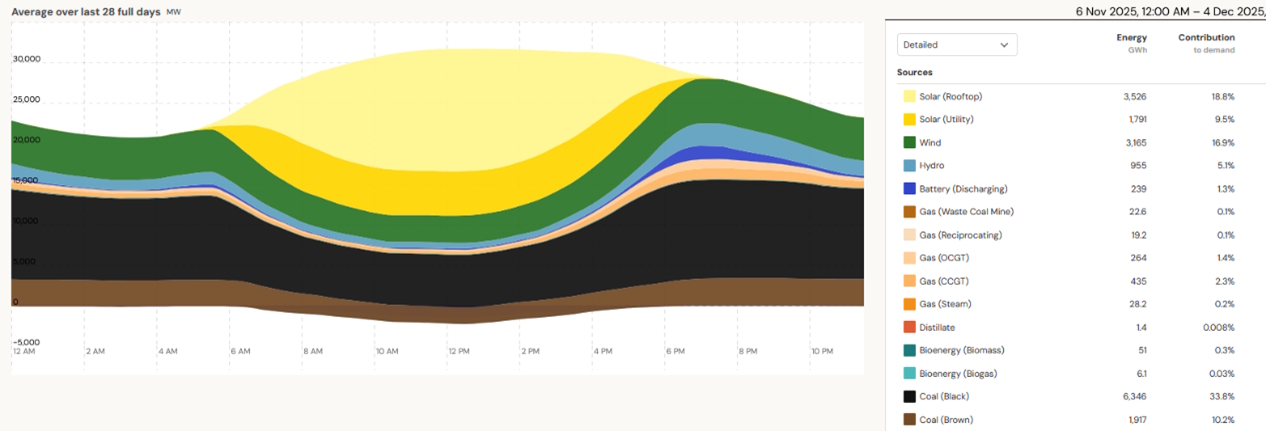
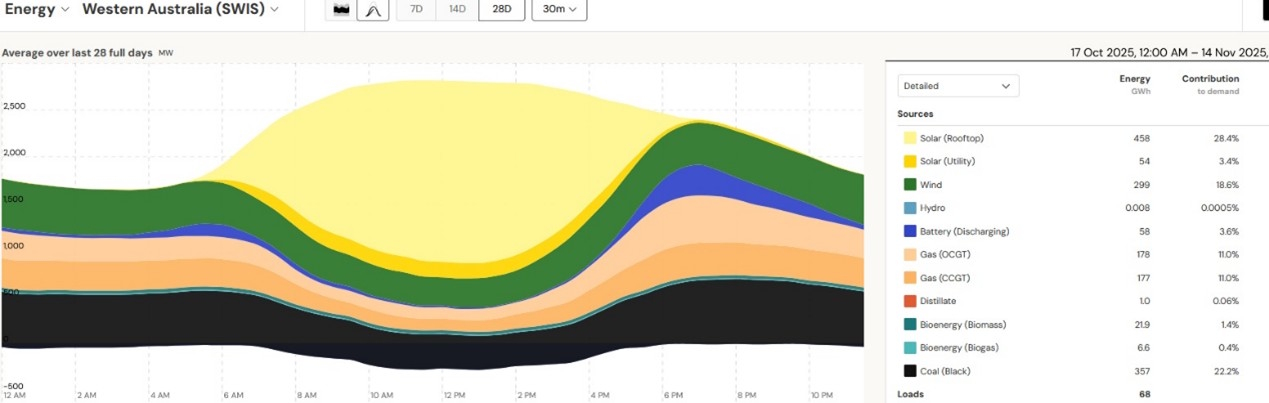
The upper chart above shows electricity generation by source for the main Australian electricity grids. The lower chart shows the same for the South West Interconnected System (SWIS), the main WA electricity grid. Both charts show the contribution of solar energy, especially rooftop solar, during the middle hours of the day. The effect is even more pronounced in WA than in the country as a whole.
The environmental impact of converting from a fossil fuel car to an EV is therefore largely contingent on when the car is charged. The EV owner who charges their car at night is to a large extent swapping one fossil fuel, petrol, for another, coal. The same applies to any other form of electrification. The householder who swaps gas hot water to electric hot water, and heats the water at night, is largely swapping gas for coal.
When to charge – convenience versus the environment
From an environmental perspective, the best time to charge an EV is in the middle of the day when the sun is contributing most to electrical power generation. In WA, the power retailer, Synergy, offers a very good plan to encourage this. Called the Midday Saver6, it offers Super Off Peak rates (currently 8.6¢ per unit) between 9:00 am and 3:00 pm. This is the perfect plan for EV and home battery owning retirees or work from homers, because they can charge their EV (and home battery) at the cheapest rates and best times for the environment, and avoid paying peak rates (and burning coal) by running their homes on battery in the evenings and through the night.
Unfortunately, most people still work away from home. They drive to work, leave their car idle in a parking lot during the day, and either charge from a public charger on their way home in the evening or at home during the night7.
Government incentives for workplace charging
The WA government used to offer a grant, the “Charge up EV charging grant”, to small business and local government, covering up to half the cost of installing EV chargers for employees and visitors. That grant closed on 30 June 2025, and does not seem to have been replaced.
Current synergy business plans11 offer a disincentive for employers to offer daytime charging to EV owners. The R1 Time of Use plan charges around $0.42 per unit from 8:00am to 10:00pm, more than three times as much as the overnight rate of $0.13.
On the plus side, under Federal tax law, the provision of electricity for employees to charge EVs usually exempt from Fringe Benefits Tax (FBT), subject to certain conditions on the EV (such as being below the Luxury Car Tax threshold for fuel-efficient cars)9.
Practicalities of workplace charging
Jaycar offers a 32 amp EV charger for $79910, which should be affordable for most businesses; but for a very small business, simply offering an EV owner access to a single phase 10 amp wall socket, should be sufficient to top up during the day for the journey home. Solar panels on the roof of the office, or built as a shade for the car park, might help to defray the cost.
Wholesale Electricity Prices
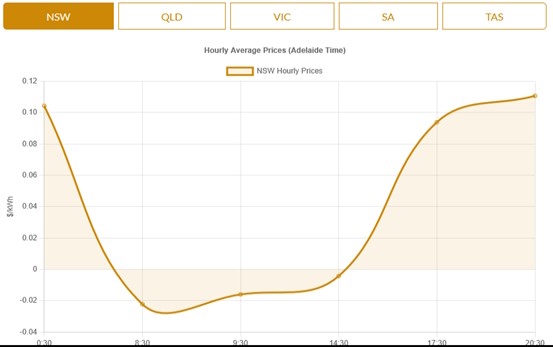
The chart above shows wholesale electricity prices by time of day for NSW12. Sadly no such chart is available for WA, but the shape is similar for other states. Essentially electricity prices are lowest during the day when the sun is out and highest at night when fossil fuels are used to meet most of the load. Retail pricing schemes such as the Synergy R1 Time of Use plan11, which charge more for electricity during the day than at night, no longer make any sense. They are anachronisms.
Possible publicity/lobbying
The WA greens were recently involved in the public event: Electrify Your Home. Maybe something similar could be organised to publicize and encourage the idea of workplace EV charging. Maybe the government could be asked why they have not renewed Charge up EV charging grant, and whether they are considering any other incentives to encourage workplace charging. Questions might also be asked about Synergy pricing schemes which encourage night time electricity consumption.
References
- Drive (URL: https://www.drive.com.au/caradvice/what-is-a-good-energy-consumption-fi…)
- Electra (URL: https://www.go-electra.com/en/newsroom/electric-car-consumption/)
- ABS (URL: https://www.abs.gov.au/statistics/industry/tourism-and-transport/survey…)
- Open Electricity (URL: https://explore.openelectricity.org.au/energy/wem/?range=28d&interval=3…)
- Electric Vehicle Council (URL: https://electricvehiclecouncil.com.au/wp-content/uploads/2024/03/EVC-Au…)
- Synergy (URL: https://www.synergy.net.au/Your-home/Energy-plans/Midday-Saver)
- Solar Choice (URL: https://www.solarchoice.net.au/ev/charging/how-long-to-charge-electric-…)
- WA Government (URL: https://www.wa.gov.au/organisation/energy-policy-wa/charge-ev-charging-…)
- EV Evolution (URL: https://evevolution.au/charging-at-work-the-australian-employees-guide-…)
- Jaycar (URL: https://www.jaycar.com.au/ev-charger-ac-7-22kw-with-5m-cable/p/ME0001)
- Synergy (URL: https://www.synergy.net.au/Your-business/Business-energy/Government-reg…)
- Jousto (URL: https://jousto.com.au/nem-spot-energy-price)
*Footnote
The author of this note has driven a Tesla Model 3 50,000 km over the last two and a half years. Energy consumption varies between local and regional driving and with weather conditions. Winter driving suits the Tesla design better than summer driving. The average energy consumption is in the order of 15kWh/km. The total energy used over the period is in the order of 7,500 kWh, which comes in at 8kWh per day, or an impact of around 350W on the home power consumption.
Prior to purchasing the car, the household consumed around 24kWh/day. This implies an average load of 1kW. The car increased that average load by about a third.
The power need was met by a 5kVA grid connected solar system on the front of the house and a 5kW private solar circuit with battery at the back. The grid connected system produces 30-40kWh/day during the summer months and 10-20kWh/day in the depths of winter. The output from the off-grid array is harder to quantify, but household consumption (excluding the car) has been measured in the range of 10-15 kWh/day. If the panels at the back absorb as much sunlight as those at the front, the combined system produces more than enough to power the house and the car during the summer, but during the winter, it is sometimes necessary to supplement the solar output with power from the grid.
Header photo: The author’s EV
[Opinions expressed are those of the author and not official policy of Greens WA]