
2026-09-08
By Rob Delves, a member of the Green Issue Editorial team
Passionate Politics: A History of the Greens in WA was launched into the world on 11th July before a crowd of around 100 Greens members and supporters. Congratulatory and stirring speeches were delivered by Larissa Waters, Parliamentary Leader of Australian Greens, Mehreen Faruqi, Deputy Leader of the Australian Greens, our own elders Jo Vallentine and Giz Watson, among others. The book was launched by Professor Fiona Stanley, on occasions somewhat tearfully as she reflected on the long and ongoing struggle of so many passionate Greens over the 36 years of our existence.
For those of you who missed out on buying the book, for $45 you can have your own copy (or get another copy for your mother, partner, nephew, political tragic colleague), in either of the following ways:
- Come into the Greens WA office at 91/215 Stirling St, Perth (Phone: 6365 2131) E: office@wa.greens.org.au Monday -Thursday 10am - 4pm.
- Online from https://uwap.uwa.edu.au/products/passionate-politics, with shipping costs added to the price.
This is an insanely wonderful read, even better than I was hoping. The official launch was also wonderful: I especially loved Fiona Stanley’s wicked sense of humour, Larissa Waters’ enthusiastic endorsement and Jo Vallentine still calling the faithful to raging action around her beloved Four Pillars – “never forget our Four Pillars” (memo to Jo, I won’t).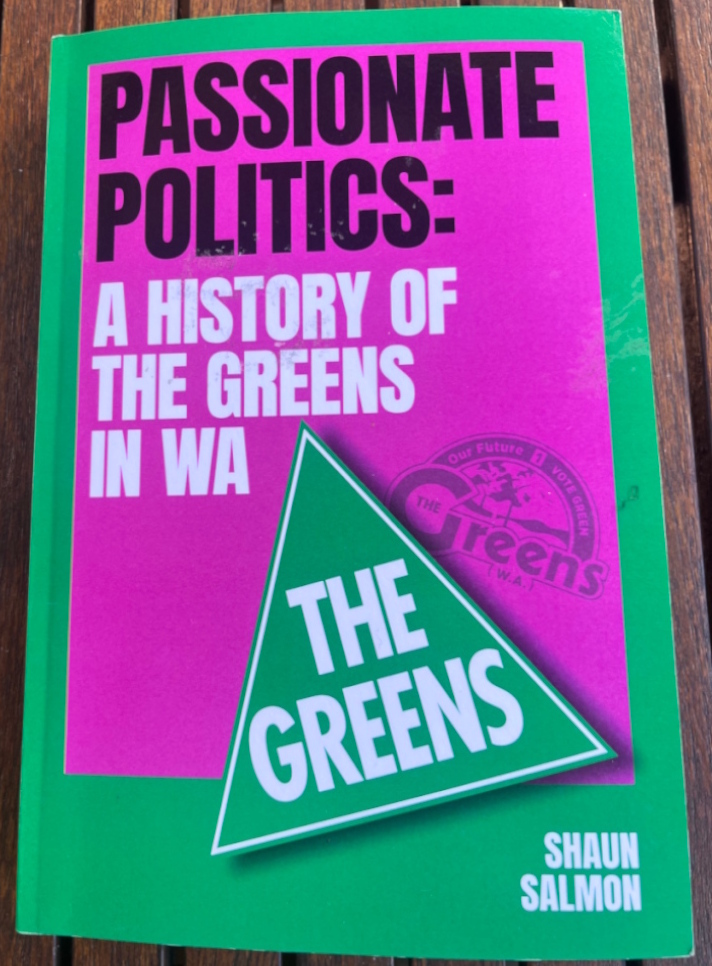
About six years ago I had read and loved Paddy Manning’s Inside the Greens: The True Story of the Party, the Politics and the People. It resonated for the same two reasons that Passionate Politics does. First, lots of fascinating stories and info about aspects of our history largely unknown to me, and secondly, learning how Greens in earlier times grappled with the big issues that still concern us today. I thought his history was fair and generous. There are tales of our obvious failures and errors and self-inflicted wounds, but the overall assessment is admiration for our staying power and grassroots members commitment to improve the party and increase our vote. I loved his conclusion that this commitment is what makes the “difference between a true political party and a personality-driven electoral vehicle”. (Obvious orange relevance to recent months!!)
I encourage you to read both but if you are time or cash-strapped, definitely go for our Passionate Politics. At least first.
Here are three examples amongst the many things I loved about the book.
1.Shaun Salmon’s introduction was much more witty, quirky and confronting than I’d expected – and a total joy because of that. He’s very open about being a sort of outsider, slightly cynical journo first of all; deeply concerned about the environment but not an activist. Above all, I loved these two sentences:
…working on this book has reminded me just how much the two major parties are owned by various industries.
The Greens are significantly less mad than those they oppose, though not without their foibles. (You’ve described me perfectly there, mate)
2. “Wow, I never knew it happened like that!” I had these Wow moments (often lengthy) on many occasions while reading Passionate Politics. The first and biggest was just about everything in the first two chapters which deal with our early history (before I joined in October 2000). I’d heard a few snippets from Jo Vallentine and my Oxfam friend and founding member Cliff Collinson. My naïve impression was several like-minded progressive groups decided they would be “better together” and they worked it out quickly via a couple of “Kumbaya Circles.” Real life is a tad more complex, passionate, difficult and exciting!
Probably the other one is the long chapter 7 entitled Clout in the House. It’s a detailed analysis of (and in my opinion, admiration for) the sheer hard work of our MPs in an often hostile environment. My overwhelming thought was “thank God I never got elected!” The focus is on several big debates our MPs have got stuck into over the years. At the state level, legislation on forests and one-vote-one value are examined in great detail.
Probably the biggest federal issue was the two attempts at carbon pricing, firstly in 2009 Rudd’s (dud) CPRS and secondly 2012 Gillard’s carbon pricing or Emissions Trading Scheme. What a difference it makes when a prime minister is prepared to negotiate in good faith and detail with MPs whose votes are needed to pass the legislation.
3. To understand today’s ongoing debates and tensions, let’s start at the very beginning. Active members know these issues well. One example: are we primarily a grassroots-driven campaigning organisation or a well-organised professional political party and election-winning machine? Another example is the importance given to the role of MPs and leaders versus local RG members. I learned a lot about these and several other issues though their repeated appearance throughout our history, with the focus on sometimes quite extended reflections by the interviewees – these are the very heart of the history and in my opinion the main reason for its success.
It is a very engaging read. Go read it, people, Mine is available to borrow, but it’s riddled with notes and comments. So, better still, buy a copy for yourself and at least a couple of your favourite people next birthday or Christmas.
Header photo: At the official launch of Passionate Politics on 11th July 2026
[Opinions expressed are those of the author and not official policy of Greens WA]