
In a state as wealthy as Western Australia, everyone should have a secure home.
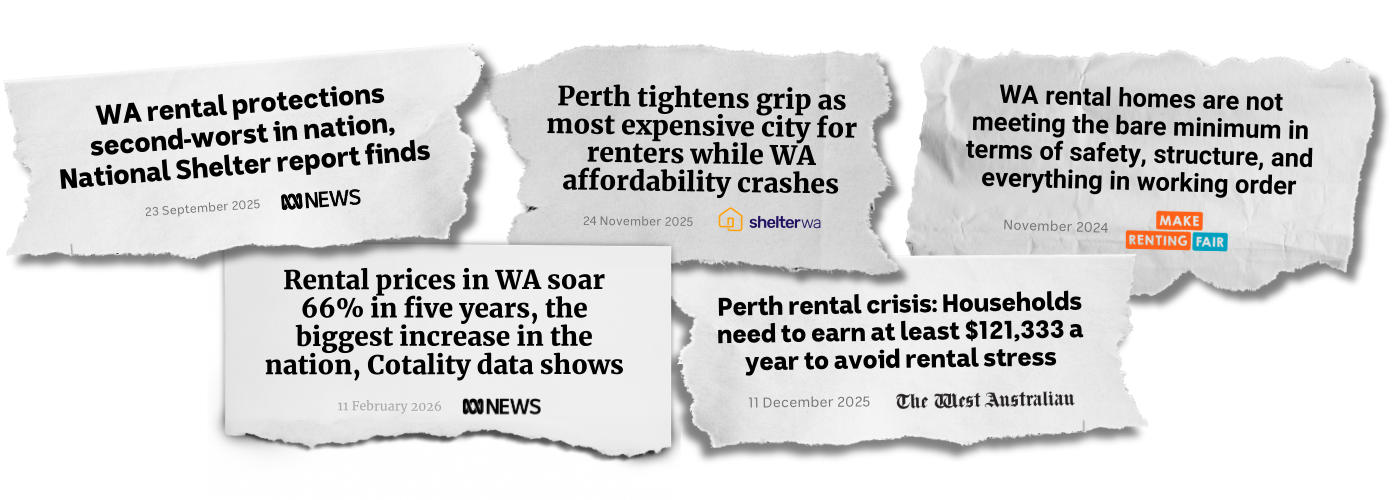
But for the roughly one-quarter of West Australians who rent, WA’s broken residential tenancy laws are leaving them powerless in their own homes – if they can even find a home at all.
WA is the second-worst performing jurisdiction in the country when it comes to renters rights. Our current laws allow landlords and real estate agents to slap tenants with evictions for no reason as well as unlimited rent increases, while lacking the minimum housing standards necessary to guarantee a safe and comfortable home.
If that wasn’t bad enough, rents are at record highs – and still rising – while vacancy rates are at historic lows.
We need bold reform to fix the rental crisis in WA.
The WA Labor Government oversaw reforms to the Residential Tenancies Act in 2024 – including a ban on rent bidding and limiting rent increases to once a year – and in May 2026 announced it would move to end no-fault evictions. While welcome, these changes don’t go nearly far enough to provide renters with the basic protections they desperately need.
The truth is, the Cook Labor Government is more interested in protecting the interests of property developers, real estate agents and landlords than ensuring every Western Australian has a place to call home.
The system is stacked against renters by design. It doesn’t have to be.
The Greens have a plan to shift the power balance away from wealthy developers and investors – and back into the hands of renters.
The Greens are fighting for:
▲ A permanent cap on rent increases pegged at CPI plus 10%. MORE ▶
▲ An immediate ban on no-fault evictions from the Residential Tenancies Act. MORE ▶
▲ Minimum standards for all private and public rental properties. MORE ▶
▲ Strong enforcement of tenancy standards. MORE ▶
▲ A portable bond scheme for WA. MORE ▶
Get involved

A permanent cap on rent increases pegged at CPI + 10%
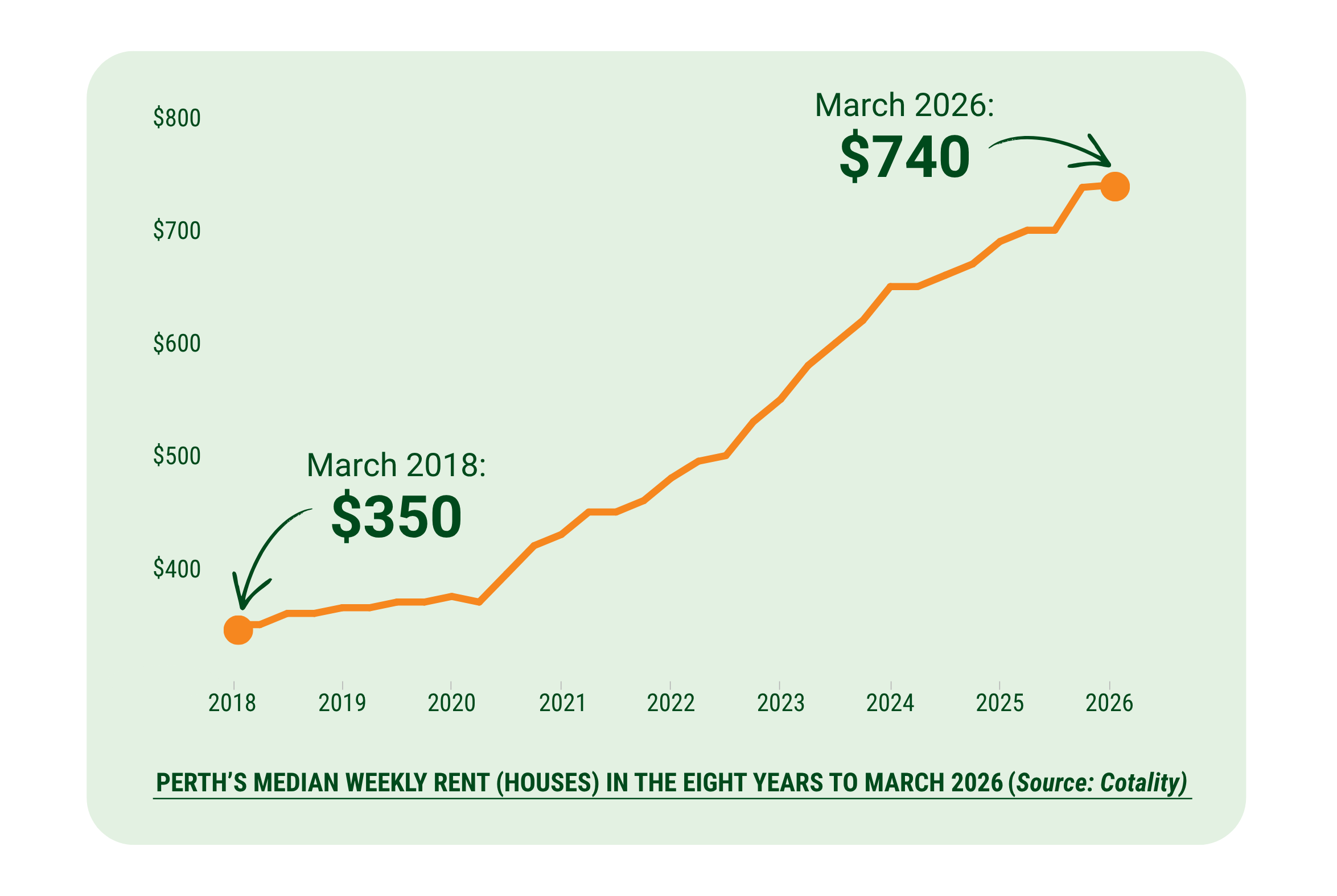
Right now, WA is one of the most expensive places to rent in Australia. In Perth, the median weekly rent has exploded from around $370 at the start of 2020 to more than $700, with growth in rental prices significantly outpacing the rest of the country.
Facilitating this runaway growth are WA’s weak residential tenancy laws, which place no limits on how much a landlord can increase a tenant’s rent. As a result, too many renters are being hit with exorbitant rent increases – sometimes up to a few hundred dollars a week – leading to a hidden form of eviction: unaffordable rent increases.
Legislating a permanent rent cap in WA would provide renters with certainty and security by placing a legal limit on how much rents can be increased.
Under the Greens (WA)’s plan, that limit would be determined by a transparent formula based on movements in the Consumer Price Index (CPI) for Perth rentals. Specifically, we would cap rents at 10% above the percentage increase in the CPI.
For example, if Perth’s CPI increase for rent is 4.8%, the maximum amount by which rent can be increased is 5.28% – that is, 10% on top of 4.8%. This means a tenant paying $650 per week could have their rent increased by no more than $34.32 per year. Increases above this threshold would require court approval or the tenant’s agreement.
These rules would apply to both fixed-term and periodic (month-to-month) tenancies.
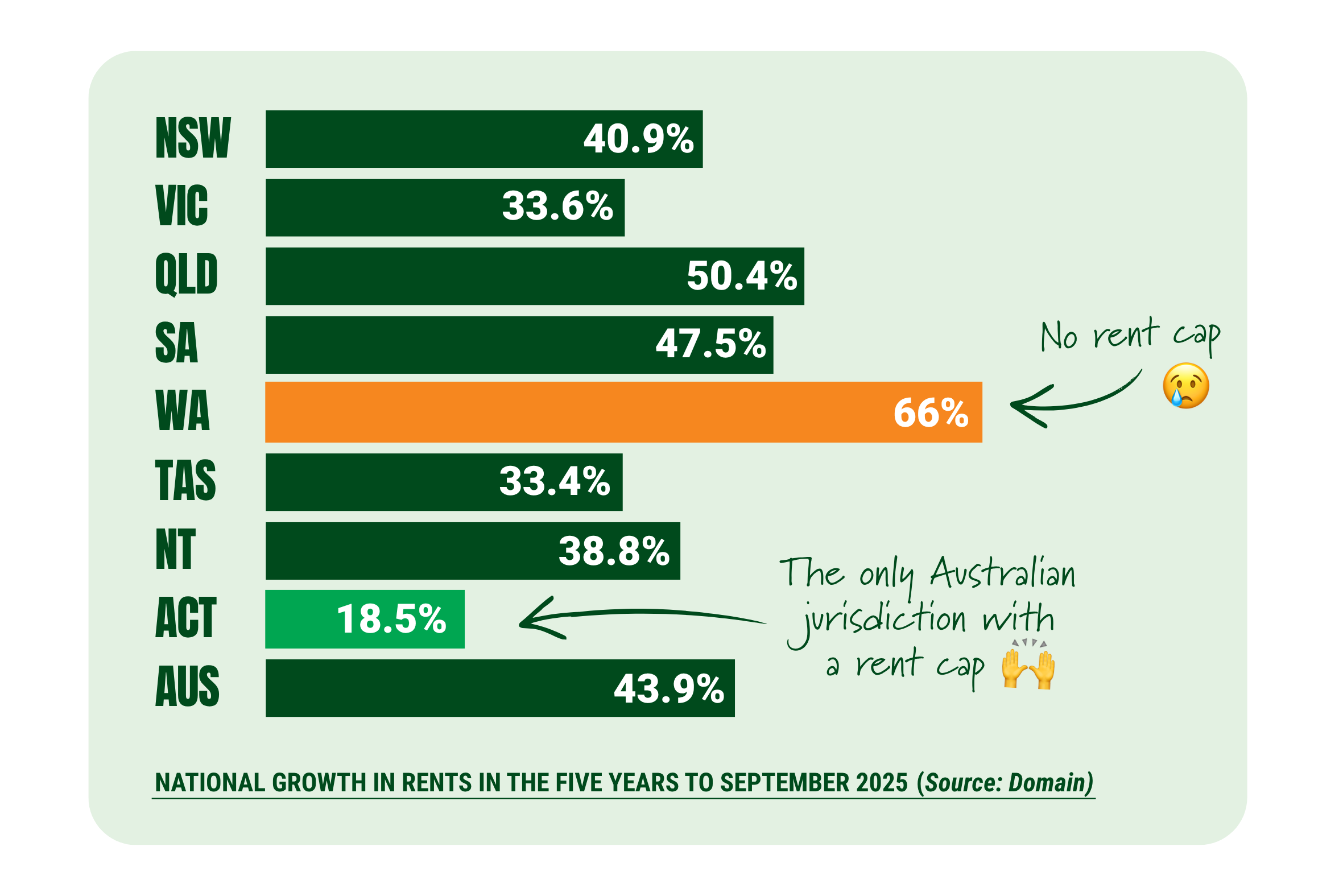
Our plan replicates the model successfully introduced in the ACT in 2019, where rent increases are strictly regulated and capped at 10% above the CPI for Canberra rentals. As the only jurisdiction in the country with such rent controls, the ACT has largely avoided the massive rent hikes experienced in other major cities in recent years, with annual rental growth consistently remaining among the lowest in Australia.
What we’re doing to make it happen
In May 2026, the Greens (WA) housing spokesperson Tim Clifford MLC introduced a rent cap bill into the state Parliament. The bill is formally lodged in the Legislative Council, with the Greens planning to bring it on for a vote as soon as possible.
AN Immediate BAN ON no-fault evictions from the Residential Tenancies Act
For years, Western Australia has lagged behind the rest of the country when it comes to banning no-fault evictions. To this day, landlords can evict renters from their homes at any time, for any reason – including no reason at all.
In May 2026, the Cook Labor Government finally indicated an intention to ban no-fault evictions – an incredibly welcome move that the sector alongside the Greens have spent years campaigning to achieve.
But at time of writing, we still don’t know exactly what approach the government will take when it comes to providing renters with this critical protection, nor when they’re likely to introduce it.
Until such time that it actually passes into law, the Greens (WA) will continue the fight to ban no-fault evictions in Western Australia. We’ll push for the ban to cover both fixed-term and periodic tenancies, with a list of genuine reasons as to why a lessor might have to end a tenancy limited to:
- moving into the property;
- housing a family member;
- selling the property;
- undertaking major works;
- changing the use of the premises.
We would also push to ensure that leases no longer terminate automatically at the end of a fixed term contract, with the tenant instead required to give notice.
What we’re doing to make it happen
We’re fighting for no-fault evictions to be banned in tandem with the introduction of a rent cap, with both provisions included in our rent cap bill currently before the Parliament.
Minimum standards for all public and private rental properties
Western Australia significantly lags behind the rest of the country for protections to ensure adequate, healthy and safe housing for renters.
Our current tenancy laws don’t contain provisions for basics such as a working kitchen, a private toilet or weatherproofing, leaving too many renters experiencing issues like mould, pest infestations, leaks and structural issues.
Rentals are also considerably more likely than owner-occupied homes to be too hot in summer and too cold in winter – often due to a lack of insulation, climate-appropriate window coverings and inefficient appliances. In a 2024 survey of WA renters conducted by housing advocacy alliance Make Renting Fair, 56 percent said they have difficulty keeping their home a comfortable temperature – a figure that jumps to 79 percent among public housing residents.
But while WA’s Residential Tenancies Act outlines the general responsibilities of landlords when it comes to the condition and maintenance of their properties, these rental standards are vague, unclear and difficult to enforce.
Coupled with insecure tenancy laws that include the threat of being evicted for no reason – plus no guarantee of finding a better home – WA renters are being left with limited power to advocate for the repairs and improvements they’re entitled to.
The Greens (WA) are calling for the introduction of strong, detailed and clear minimum standards in WA.
THIS INCLUDES:
- Explicitly outlining discrete standards that cover a rental home’s structure, safety, security, accessibility, amenities and other factors relevant to ensuring a tenant’s comfort, safety and enjoyment
- Mandating minimum standards for heating, cooling and energy efficiency, including a full retrofit of all social housing by 2030 to meet the minimum 7-star energy efficiency rating under the Nationwide House Energy Rating Scheme
Strong enforcement of renter protections
Right now, the power balance is tipped overwhelmingly in favour of real estate agents and landlords – and away from renters, leaving them with few avenues through which to make complaints, advocate for their rights or hold bad behaviour to account.
The Greens (WA) will push for a range of measures to protect the rights of renters.
THIS INCLUDES:
- A robust residential tenancy compliance and enforcement taskforce designed to safeguard tenants’ rights across multiple areas. This could look like New Zealand’s Tenancy Services Compliance and Investigations Team, and would be empowered to:
- conduct random inspections of rental properties
- undertake independent investigations of alleged breaches
- issue infringements for breaches
- A three-strike policy for real estate agents, and fines for private landlords, who engage in unfair practices like:
- encouraging rent-bidding or accepting bids above the advertised price for a rental property
- misleading advertising, including the use of AI-altered images
- The introduction of a new offence for landlords who begin a lease on a property that does not comply with minimum rental standards
A portable bond scheme for WA
Moving between rentals can be a time of significant financial stress, with many renters forced to pay a double bond – that is, fronting up a bond for their new property while still awaiting the return of their old bond. And with the standard rental bond in WA equivalent to four weeks’ worth of rent, that often means being left out of pocket thousands of dollars for weeks or even months.
The Greens (WA) will push for the establishment of a portable bond scheme in WA, allowing renters to transfer their existing rental bond directly to a new property. This could draw from NSW’s Smart Rental Bonds scheme, which is due to be rolled out this year.